Gay Express
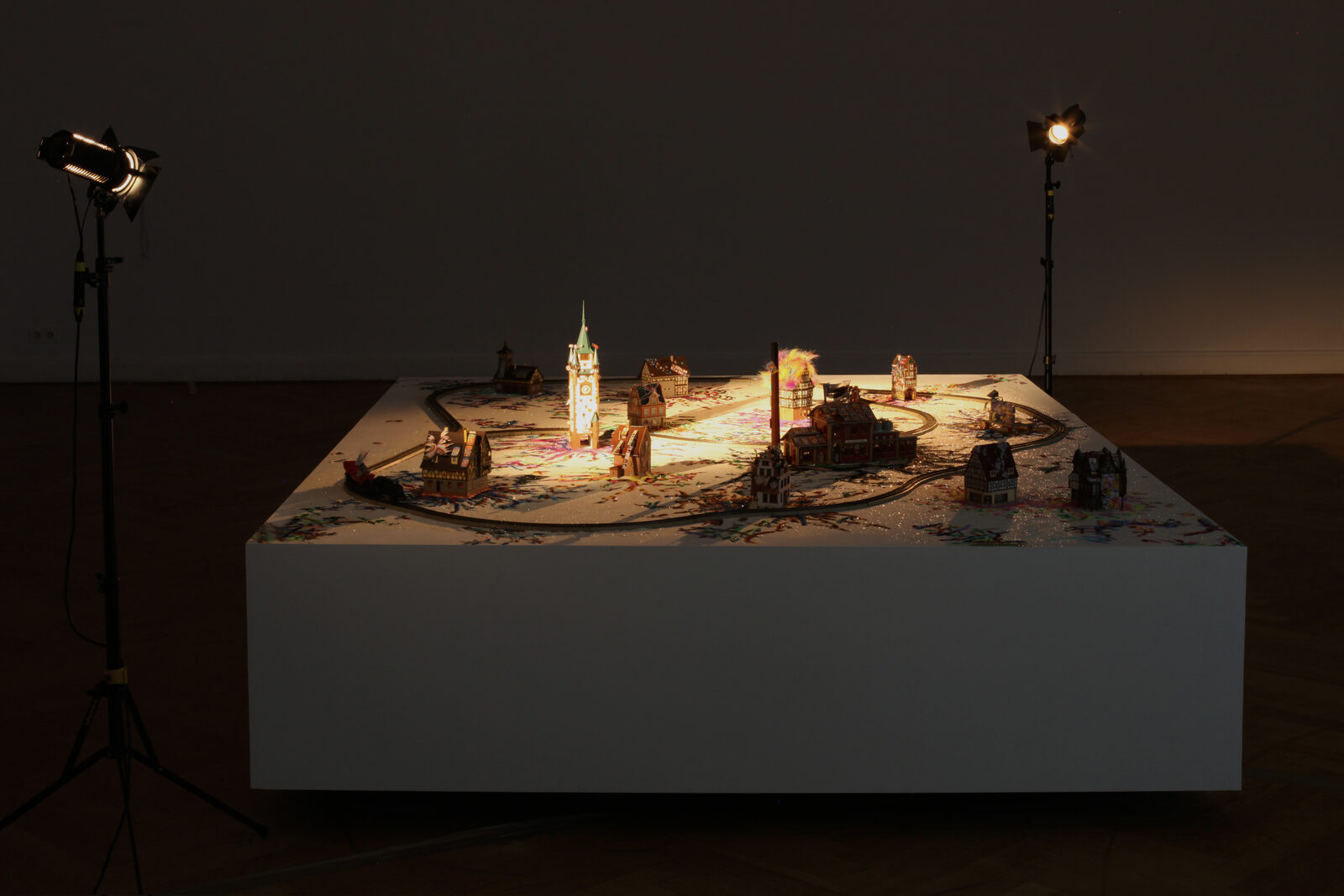
Installation
“The whole island was vomiting up color like a drunk and here in the corner, in plastic filtered light, was one spot of sane, refined mauve.“
— Toni Morrison, Tar Baby (New York: Signet, 1983), p. 161.
Our wishes and drives are part of infrastructure, according to Deleuze and Guattari. The socius, a societal machine, occupies our wish production while simultaneously being its reproduction. It renders flows of desire bijective and univocal by subjecting them to a master signifier. The master signifier functions like a matrix, it is the model of serial production par excellence: everything becomes recognisable and uniform. Where desiring machines are fundamentally poly-vocal following a logic that constantly leaps, thus creating impossible connections like combining roughness with a toy or a colour, the matrix introduces non-ambiguous codings formatting the logic of wishes until they can be threaded on a strand and always look alike: mechanical Platonism.
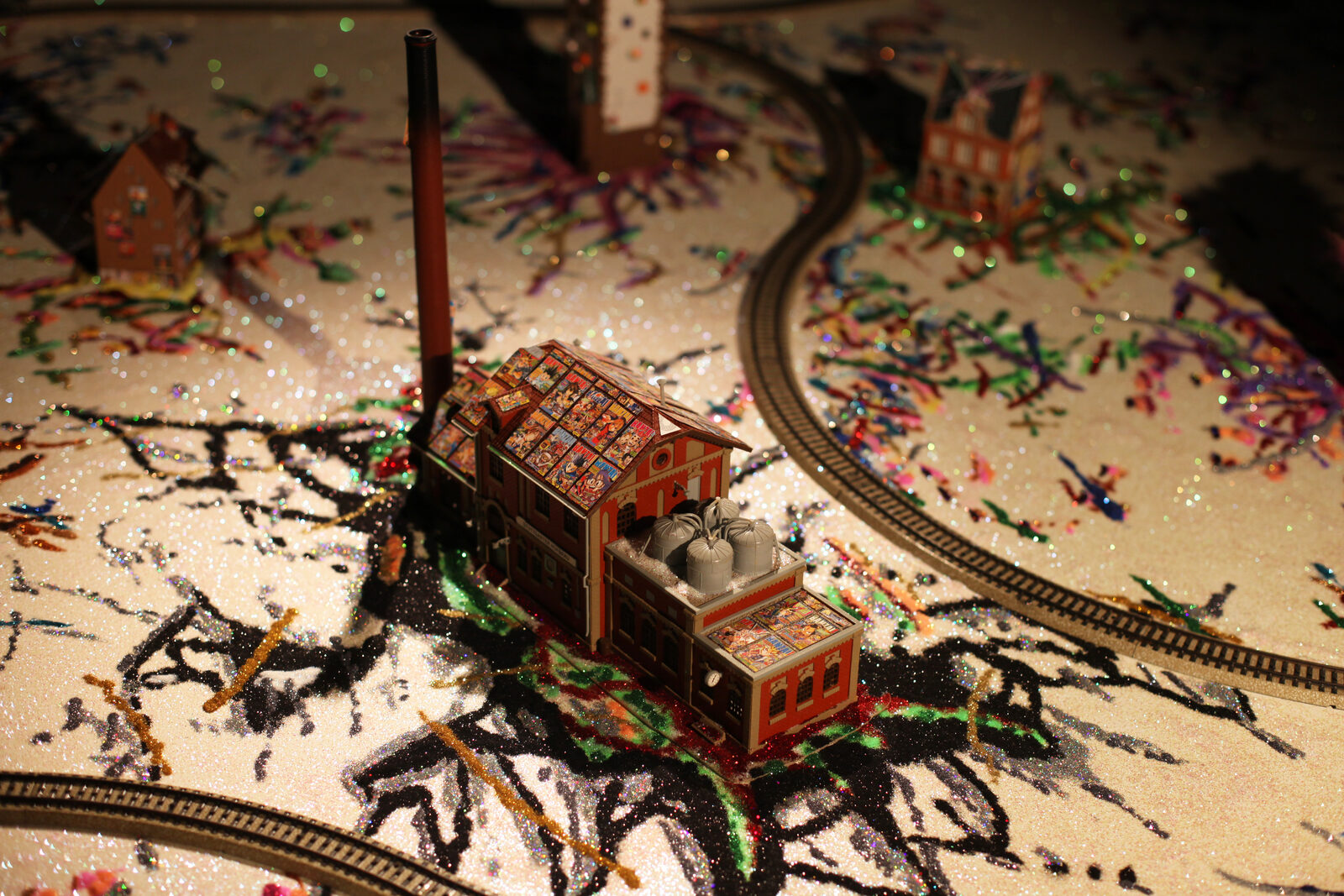
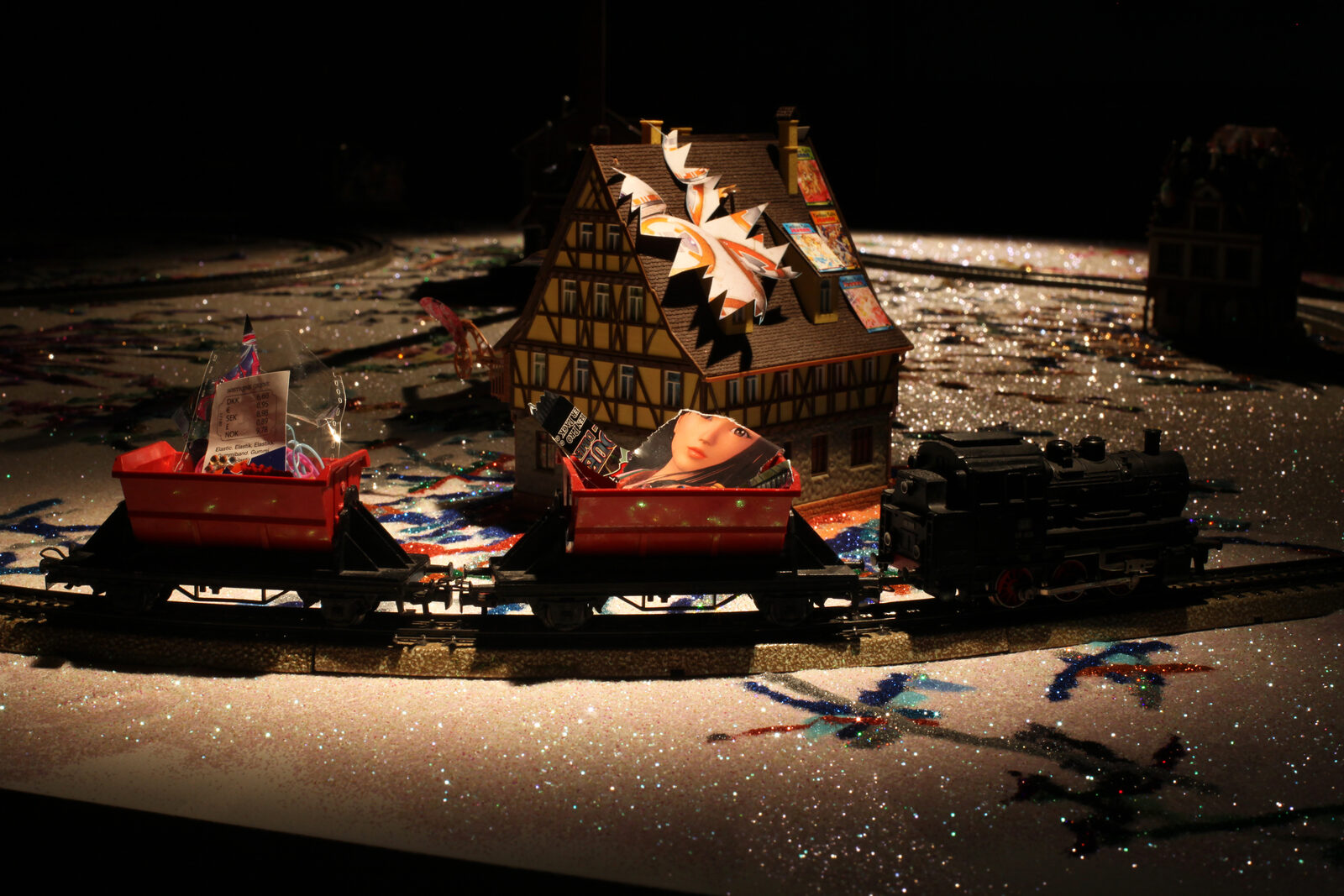
This mechanical production is not consciously perceived as a process of world-making. Instead, it is only indirectly experienced as a spatial texture. Like fine glitter, it rests on the vestiges of older structures. Timber framing, childhood, ‘everything happens again’, is overwritten and reformatted. Capitalism installs a sort of transcendental narcissism: the pair of desire and desired is always already a circular motion, a dyadic closure.
Insofar as the occupation of the desiring machines by the socius implies their despotic linearisation, societally mediated desire can only be the expression of a conflict. Exactly this sort of perverse wish economy, according to Marx, is false consciousness. The productive forces of society perpetuate this circulation. From the circle of permanent production and consumption, there is no true departure toward a true modernity. This too is the principle of social astrology: the locomotive never departs from its course. Under the yoke of parasitic matrices, everything remains the same. Architecture clad in ideology doesn’t grow new spaces.
Text by: Felix Clausberg
First published in: Jahrbuch der Hochschule für bildende Künste Hamburg (Material Verlag der HFBK Hamburg, 2017). Translated and lightly revised for this edition.